Review of the Federal Dention Center in Los Angeles
Introduction
Local governments are responsible for operating certain detention facilities (such equally jails) to incarcerate people in various stages of the criminal justice organization. Detention facilities often engage in high stakes activities—including commitment of wellness care and use of strength—that can take life and death consequences for those incarcerated also as staff. Accordingly, proper facility policies and operations are disquisitional to ensuring safety and humane treatment, protecting the rights of those incarcerated, and minimizing exposure to legal liability.
Several states—including California—set minimum standards for the operation of local detention facilities and inspect facilities relative to those standards. Such programs tin provide land aid for and oversight of local detention facilities. The operation of local detention facilities is currently of item involvement to members of the Legislature in light of recent concerns raised effectually weather of jails in California.
In this report, we (1) provide an overview of local detention facilities in California, (2) assess the state's program for setting minimum facility standards and inspecting these facilities, and (3) recommend steps to help ensure the success of the program going forwards.
Background
Overview of Local Detention Facilities
In California, counties are responsible for detaining, in secure facilities, both youth and adults who (1) have been arrested for a crime and are awaiting trial or court decisions or (2) are serving time for committing a crime. In addition, some city law departments operate detention facilities used to detain arrestees on a brusque‑term basis. In total, there are nearly 550 local detention facilities in the state.
Adult Detention Facilities
Firm Adults in Various Stages of the Criminal Justice Organisation. As shown in Effigy 1, there are 457 local detention facilities that house people in various stages of the adult criminal justice system. Of these, 281 are operated by counties and 176 are operated past cities. These facilities include:
- Jails. These facilities can business firm people for pregnant periods of time including while they are serving multiyear sentences, though also may hold people for brusque periods following arrest. Statewide, jails take a capacity of 80,000 and had an average daily population of 73,500 in 2019. Of this population, 67 percent were unsentenced, 82 percent were charged with or convicted of a felony, and 87 percent were male.
- Short‑Term Detention Facilities. These facilities hold people for less than 96 hours, such as some constabulary facilities that concur people following arrest. Statewide, curt‑term detention facilities accept a capacity of 4,000. The country does not collect population data for these facilities.
- Holding Cells. These facilities hold people for less than 24 hours, such every bit courthouse cells that concord people for their hearings. The state does not collect capacity or population data for these facilities.
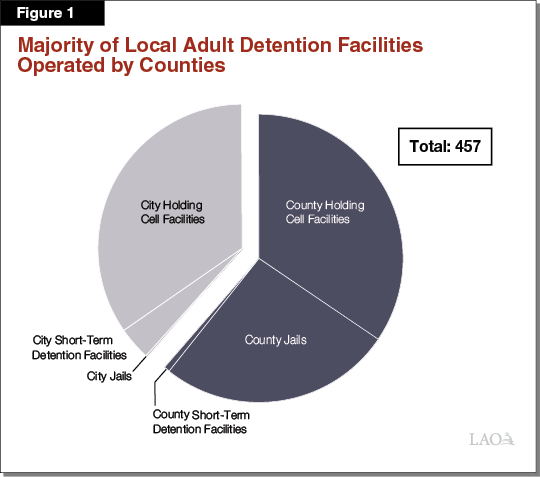
While counties operate all of the different types of facilities, cities more often than not operate holding cells and short‑term detention facilities, though 1 city—Santa Ana—operates a jail.
Typically Operated by County Sheriffs or Police Chiefs. County detention facilities are more often than not operated past elected sheriffs while city detention facilities are operated by chiefs of police who are appointed by elected metropolis officials. Sheriffs and police chiefs typically maintain internal policy and procedure manuals that instruct staff in matters of facility operations. For example, a jail's policy regarding external visitors may outline when staff can deny or terminate a visit, such every bit if the visitor is nether the influence of drugs or alcohol. Ultimately, sheriffs—who have wide and straight potency over facility operations—and county boards of supervisors—who allocate funding to sheriffs—are responsible for conditions inside county‑operated detention facilities. Chiefs of police, as well as the city officials who appoint and oversee them, are responsible for conditions inside metropolis‑operated detention facilities.
Juvenile Detention Facilities
House Youth in Various Stages of Juvenile Justice System. California's juvenile justice system, which is oriented around the treatment and rehabilitation of juvenile offenders as opposed to penalization, has a broad array of methods and programs for addressing juvenile crime. Depending on the severity of the offense and the background of the offender, youth may be placed in detention facilities while their cases are being heard in courtroom and/or to receive rehabilitative treatment. Currently, there are 90 local detention facilities in California that business firm youth. Every bit we discuss below, all of these facilities are operated by counties. There are generally two types of juvenile detention facilities:
- Juvenile Halls. Juvenile halls concur youth who take been arrested and/or are having their cases heard in juvenile courts and are not allowed to remain at domicile. They besides hold youth placed at that place to receive rehabilitation programming and youth serving brusque stints of incarceration for violating the rules they must follow while nether supervision in the customs. There are l juvenile halls in California, which together take a chapters of well-nigh seven,200 beds. In 2019, the boilerplate daily juvenile hall population was well-nigh ii,500. Of this population, about 65 percent were being held before a approximate had decided their case.
- Juvenile Camps and Ranches. Juvenile camps and ranches are responsible for belongings youth placed there to receive rehabilitation programming offered at the facilities after a gauge has decided their case. In that location are forty juvenile camps and ranches in California, which together have a capacity of about 4,000 beds. In 2019, the average daily camp and ranch population was about ane,200.
Operated past County Main Probation Officers. Canton juvenile justice systems—including juvenile facilities—are operated past county probation departments headed past primary probation officers. Chief probation officers are either appointed by the state trial court located in the county or by the county lath of supervisors. The board of supervisors determines what level of funding to allocate to the probation department. Probation departments typically maintain internal policy and process manuals, which instruct staff in matters of facility operations. Ultimately, the principal probation officer, county board of supervisors, and courtroom are responsible for atmospheric condition inside juvenile facilities.
State Support for Local Detention Facilities
Country Funding for Performance and Construction Costs. While counties and cities are primarily responsible for funding local detention facilities, the state provides some funding to support these facilities. For case, in 2011, the state enacted legislation to realign to counties the responsibleness for incarcerating and supervising certain felony offenders. To pay for this realigned workload, the state provides counties with a portion of annual state sales tax revenue, which has totaled effectually $one billion in recent years. Counties use a significant share of these funds to back up jails. In add-on, the state has sometimes provided one‑time funding to support the structure of local detention facilities. Since 2007, the country has authorized charter revenue bonds of virtually $2.v billion to fund the construction and modernization of jails and $300 million for juvenile facilities.
Other State Assistance for Local Detention Facilities. In add-on to providing certain funding for local detention facilities, the state establishes minimum standards for the choice and training of local correctional staff at the facilities, monitors compliance with the standards, develops core training curricula for entry‑level staff, and certifies other preparation courses. In addition, the state establishes minimum standards for the edifice and performance of local detention facilities, which nosotros discuss in greater detail below.
BSCC Responsible for Establishing State Standards and Inspecting Local Detention Facilities
Overview of Board of Land and Community Corrections
The Lath of State and Community Corrections (BSCC) was established in 2012, though similar agencies have existed in various forms since the 1940s. Nether existing state law, BSCC is responsible for providing statewide leadership, coordination, and technical assistance to promote constructive state and local efforts and partnerships in California's adult and juvenile justice systems.
Main Responsibilities. BSCC has four main responsibilities: (i) setting standards for and inspecting local detention facilities, (2) setting standards for selection and preparation of local correctional staff, (3) administering various state and federal grant programs related to recidivism reduction and prevention strategies, and (iv) administering the land's construction financing program for local detention facilities. The 2020‑21 budget provides BSCC with $348 million ($136 yardillion General Fund) to conduct out these responsibilities. Of this corporeality, $315 thouillion is expected to exist passed through to local governments and other entities. Of the $33 million retained by BSCC, $2.7 k illion—as well as viii.4 staff positions—supports the standards and inspections program. (We note that this is roughly the same level of resources proposed for the program in the Governor's budget for 2021‑22.)
Governance. Equally shown in Figure 2, the agency is overseen by a thirteen‑member board. In addition to a chair, statute requires the board to include 2 administrators from the California Department of Corrections and Rehabilitation (CDCR), five local law enforcement officials, one county supervisor or administrative officeholder, a judge, 2 providers of rehabilitative services, and a member of the public. Ten members—including the chair—are appointed past the Governor and bailiwick to Senate confirmation. The Judicial Council, Speaker of the Assembly, and the Senate Commission on Rules each appoint ane member. Statute requires the board to select either a sheriff or a principal probation officer from amidst its members to serve equally vice chair. The chair of the lath is a full‑time paid position while the remaining members receive reimbursement for whatever expenses incurred every bit a board fellow member, such as travel costs. The agency is managed past an executive director who is appointed past the Governor and subject to Senate confirmation.
Figure 2
BSCC Board Includes Country and Local Officials and Service Providers
| Appointed by Governor and Confirmed by Senate |
|
| Appointed by Others |
|
| aSmall-scale defined every bit a chapters of 200 or fewer inmates. Large defined as capacity over 200 inmates. bSmall defined as population of 200,000 or fewer. Big divers equally population over 200,000. |
| BSCC = Lath of State and Customs Corrections; CDCR = California Department of Corrections and Rehabilitation; and DAPO = Sectionalisation of Adult Parole Operations. |
Executive Steering Committees and Working Groups. Statute requires the board to regularly seek advice from a balanced range of stakeholders and subject matter experts. This is to ensure that the board's efforts (1) are well‑informed by experts, (2) include the participation of those affected by board decisions, and (3) promote collaboration and innovative problem solving. In order to fulfill this requirement, BSCC uses:
- Executive steering committees (ESCs) that are appointed by the board to carry out specified tasks and provide findings and recommendations every bit needed. For example, BSCC routinely appoints an ESC to oversee the review of local detention facility standards and recommend changes. The board either approves, rejects, or revises those recommendations.
- Working groups that are appointed by ESCs to carry out subtasks and make recommendations. For case, the ESC tasked with reviewing local detention facility standards convenes multiple working groups, each focused on a particular subject field area (such equally nutritional health). These working groups review the standards relevant to their subject area and recommend revisions to the ESC.
Local Detention Facility Standards and Inspections Program
BSCC Required to Perform Sure Activities Related to Facility Standards. The state start created minimum standards for local jails in the 1940s afterward a statewide survey of jails constitute them in need of comeback. The standards were starting time administered by the State Lath of Corrections, which later evolved through various regime reorganizations into BSCC. The standards have been revised over time—including with the addition of standards for juvenile detention facilities—and are currently codified in Titles fifteen and 24 of the California Code of Regulations. Current state law requires BSCC to perform the following specific activities, which make upwardly the core of the standards and inspections program:
- Maintain Minimum Standards for Facility Construction and Operation. BSCC is required to create minimum standards for construction and operation of local detention facilities, too equally review and consider revisions to the standards once every ii years. This work is done primarily by ESCs and working groups generally consisting of detention facility managers and advocates for inmates and detained youth, every bit well as formerly incarcerated people. In selecting members for these groups, statute requires that BSCC staff seek to include individuals with expertise and diverse perspectives.
- Inspect Each Facility Every Ii Years. BSCC is required to inspect each local detention facility once every two years to assess compliance with the above standards. Inspectors review policy manuals and other written documentation of facility processes and procedures to assess their compliance with the standards. In addition, inspectors assess whether operations match policy by touring the facility; interviewing staff, inmates, and detained youth; and reviewing documentation of operations (such as log books and grievance forms). Following the inspection, BSCC staff continue to work with facility staff to develop and implement a corrective action programme if areas of noncompliance are identified.
- Report on Facilities' Compliance With Standards. Statute requires BSCC to provide inspection reports to facility administrators and certain other local officials, such every bit the presiding approximate in the county. BSCC is required to post all inspection reports on its website and submit a summary written report to the Legislature every other year. This summary report must include a list of noncompliant facilities, the specific standards these facilities did not run into, and the estimated cost to each facility of achieving compliance. We note, however, that BSCC does non report estimated costs for compliance. According to BSCC, such information is not collected and would exist speculative.
BSCC Not Authorized to Enforce Standards. While statute requires BSCC to report which developed detention facilities are non in compliance with the standards, it does not give BSCC a mechanism to enforce the standards (such as by fining facilities). If BSCC finds juvenile detention facilities out of compliance, it is required by land police force to promptly notify the facility operator and those who have dominance to place minors in the facility. If the reason for noncompliance is not addressed within 60 days of the notification, state police prohibits minors from being housed in the facility until the issue is remedied. However, as with the standards for adult facilities, land law does non authorize BSCC to enforce this prohibition.
BSCC Modifying Program. In recent years, high profile cases of inmate mistreatment covered in the media have raised concerns about conditions inside California jails. Many of these cases point toward systemic bug, non only isolated incidents. Following these concerns, and citing an overall insufficient level of accountability and oversight of jails across the country, the Governor directed BSCC in January 2020 to make the post-obit changes to the standards and inspections program:
- Ensure Standards Are Consistent With National Best Practice. As part of its existing biennial standards revision process, BSCC staff have started providing the working group members with reading materials on possible best practices for operating detention facilities. Staff too ask members to confirm they are considering best practices in their revision process.
- Prioritize Inspections and Technical Assistance for Facilities With History of Noncompliance. BSCC has begun conducting additional inspections and providing technical help at facilities that were establish in the previous inspection cycle to take more than than two significant items of noncompliance. These additional inspections are focused on the facilities' specific areas of noncompliance and do not replace their standard biennial comprehensive inspection.
- Highlight Noncompliance Through Public Board Meetings. BSCC plans to implement a new process to highlight cases of detention facilities failing to comply with standards. Specifically, BSCC will enquire agencies that practice not address areas of noncompliance within specified fourth dimension periods to appear before the board at a public meeting to discuss why they are not compliant. However, attendance is optional and if an agency declines to attend, in that location are no further consequences associated with noncompliance.
Standards and Inspections Plan Lacks Articulate Mission and Goals
The BSCC standards and inspections plan provides an opportunity for state help for and oversight of local detention facilities. As such, it is important to ensure that the plan operates finer, peculiarly in light of recent concerns shared by the Governor and members of the Legislature regarding weather inside local detention facilities. Based on our review of the current standards and inspections program, even so, we discover it hard to assess the programme'due south effectiveness. As we discuss below, this is primarily because the program lacks a conspicuously defined mission and goals from which to measure specific program outcomes.
Programme Mission and Goals Not Specified in Statute. Equally discussed above, existing state law requires BSCC to maintain standards for local detention facilities, audit these facilities, and issue reports on their compliance with the standards. However, state law does not specify the mission or goals BSCC should pursue as it carries out these activities. As such, it is unclear whether the intended mission of the program is to help local government in determining legal requirements for facility weather, create statewide uniformity in facility operations, ensure humane and safe atmospheric condition, or something else.
Leaves Significant Discretion to Administration to Ascertain Mission and Goals. The absence of a defined program mission and goals in statute leaves significant discretion to BSCC and the administration in determining how to operate the program. Based on conversations with BSCC staff and other stakeholders, there appears to be some consensus that the electric current informal mission of the program is generally to promote legal, humane, and prophylactic conditions for inmates, detained youth, and staff. However, since this specific mission in non specified in statute, zippo prevents the electric current administration from operating the program based on a different mission.
Furthermore, the lack of clearly divers goals in statute leaves meaning discretion to BSCC and the administration in how to further whatever informal mission it chooses to adopt. For case, the following two goals would both generally support the mission of promoting legal, humane, and rubber detention weather: (i) supporting facility administrators in complying with evolving court decisions on detention weather and (ii) providing external oversight of local detention facilities. An bureau with the first objective may develop reports written for facility administrators to assist them modify their operations to avoid lawsuits. Such reports would not need to be easily understood past the public. In dissimilarity, an bureau with the second objective would likely release reports detailing violations in layperson's terms to allow stakeholders to hold facility administrators accountable.
Undermines Legislative Oversight. Without clear program mission and goals, information technology is difficult for the Legislature to assess whether the program fulfils an important land office that is consistent with its priorities. This includes whether the programme is accordingly structured and resourced or should even continue to be. Moreover, to the extent the programme does continue to exist, the lack of clear goals makes it hard for the Legislature, too every bit the full general public, to appraise whether the program is operating effectively and achieving its goals.
Recommendations to Ensure Success of Standards and Inspections for Local Detention Facilities
In view of the above concerns, we recommend that the Legislature adopt legislation to establish a clear mission and goals for the standards and inspection plan for local detention facilities. In item, we recommend that the program's mission exist to promote legal, humane, and rubber conditions for the youth and inmates in local detention facilities—who tend to be among order'south most vulnerable groups—as well as the staff who work at the facilities. Based on our proposed mission and goals, nosotros likewise recommend that the Legislature restructure the membership of BSCC to aid ensure that they are achieved. Lastly, we recommend requiring BSCC to develop a plan for adjustment the current standards and inspection plan to our proposed mission and goals.
Overall, we detect that our packet of recommendations will help ensure the success of the local detention facility standards and inspection programme going forwards. Moreover, they will help address recent concerns nearly conditions within local detention facilities past increasing transparency and better supporting local efforts to improve facility conditions. Figure 3 summarizes our recommendations, which we hash out in more detail below.
Effigy iii
Recommendations to Ensure Success of
BSCC Standards and Inspections Program
|
|
|
| BSCC = Board of Land and Community Corrections. |
Establish Articulate Program Mission and Goals
Program Mission: Promote Legal, Humane, and Rubber Conditions. Based on our discussions with various stakeholders (such as representatives of sheriffs and chief probation officers, every bit well as advocacy groups that focus on the welfare of inmates and detained youth) and review of all-time practices, nosotros recommend that the Legislature establish in statute that the mission of the standards and inspection programme is to promote legal, humane, and rubber weather condition for youth, inmates, and staff in local detention facilities. This mission is generally consistent with what appears to be the current informal mission of the program. In add-on, we recommend the Legislature adopt in statute the specific programmatic goals to further this mission, which we talk over below. Later in this report, we discuss the extent to which the current program is aligned to these goals and make recommendations for how BSCC membership and the standards and inspection programme could be restructured to better align with them.
Program Goal: Maintain Standards That Help Local Leaders Determine and See Legal Requirements. Much of what defines legally acceptable conditions of detention is based on decades of past courtroom decisions. In the procedure of deciding these previous cases, courts resolved ambiguities in the law—setting a precedent for how later courts analyze similar issues. This is oft referred to every bit "instance law." For example, in 1993, the United States Supreme Court held, in a case known as Helling v. McKinney, that assuasive inmates to be exposed to second‑hand fume could institute a violation of the United States Constitution's prohibition on savage and unusual punishment. This ruling established a principle that inmates may challenge detention conditions without sustaining an injury if they can show that the condition puts them at serious risk of time to come injury. This principle has implications for the legality of other aspects of detention facilities, such as a facility'due south ability to command the spread of infectious diseases.
Not just does case police continue to evolve every bit new court decisions are made, only information technology can exist difficult to interpret it into practise. For case, due to the principle established in Helling 5. McKinney, detention facilities must prevent infectious diseases from putting inmates at risk of serious future injury. Even so, determining the primal elements for a policy to command the spread of infectious diseases may require medical and public health knowledge that facility administrators practise not necessarily have.
Accordingly, it is important for facility administrators to continually monitor and translate case police force specific to local detention facilities into exercise. However, considering of the inherent difficulties involved, state agencies can assist facility administrators with this work. For example, BSCC'south current standards specify that facilities must screen inmates and detained youth upon inflow for symptoms of infectious diseases. Moreover, it is probable more than efficient for a unmarried entity—the state—to translate case law into standards than for each facility to do so separately. Furthermore, by inspecting facilities relative to these standards, the state tin can provide an independent assessment to assist facility administrators ensure their facility is operating consistently with what the law requires. Such a programme tin benefit inmates and detained youth by promoting legal detention weather, as well as aid local regime reduce their exposure to lawsuits. Accordingly, we recommend that an explicit goal of BSCC's standards and inspection program be to maintain standards that assist local governments to effectively determine and run across legal requirements.
Programme Goal: Facilitate Transparency and Accountability Through Standards and Inspections. Local detention facilities engage in high‑stakes activities—including delivery of health intendance and use of forcefulness—that tin have life and death consequences for inmates, detained youth, and staff. Accordingly, facilities crave heightened oversight that is tailored to the correctional setting. All the same, there are special challenges to ensuring transparency and accountability in detention facilities, which make external oversight of these facilities particularly important. For instance, since detention facilities are removed from public view, natural transparency around the conditions inside them is limited. In addition, the public may not choose to actively scrutinize detention facilities because such facilities affect a relatively small portion of the population and one that is frequently considered "unsympathetic" due to being accused or convicted of crimes.
At that place are various entities engaged in external oversight of local detention facilities, every bit described in the box beneath. Well‑structured state standards and inspections programs are well‑positioned to contribute to this overall system of oversight. As discussed above, standards programs can help facilities meet legal requirements. Still, standards can also encourage generally accepted practices that promote humane conditions and staff condom. For case, case police requires facilities to serve nutrient that is nutritious and prepared under make clean conditions. Nonetheless, stakeholders may experience requiring i hot meal per day is appropriate because it promotes humane weather condition and inmate morale, which in turn, improves staff safety. By maintaining standards and inspections for all local detention facilities, the state tin provide local leaders—such as sheriffs, boards of supervisors, or juvenile court judges—with an independent assessment of how facilities compare to generally accepted practices. They can then use this information to make changes as needed. Furthermore, other stakeholders—such as facility staff or community groups—may choose to utilise this information to hold facilities and/or local leaders answerable for making such changes. Accordingly, we recommend that an explicit goal of the BSCC standards and inspections program be to facilitate transparency and accountability through standards and inspections.
External Oversight of Local Detention Facilities in California
Local detention facilities typically accept multiple entities overseeing them, including entities from dissimilar levels and branches of government as well as nongovernmental entities. These entities oftentimes take different stakeholders and levels of authority over facilities. In addition, they often use different methods of oversight and assess facilities relative to different benchmarks. In California, various entities (in addition to the Lath of State and Community Corrections) provide oversight of local detention facilities. These include:
- State and Federal Courts. Courts assess whether violations of law accept occurred. At least 11 California counties have recently been bailiwick to grade wide court injunctions or consent decrees on jail conditions or are in the process of negotiating them. For case, inmates at the Santa Barbara County Jail sued Santa Barbara County and the Sheriff's Office in 2017 claiming that the jail violated state and federal law by (1) failing to provide bones health care; (ii) overusing solitary confinement; (3) discriminating confronting people with disabilities; and (four) providing inhumane, unsanitary, and unsafe living conditions. In 2020, the parties reached a settlement agreement under which the county will brand several meaning changes to jail policies and practices, such as implementing an electronic health records system.
- U.s. Section of Justice (U.Southward. DOJ). Federal law allows the U.Due south. DOJ to conduct investigations of declared civil rights violations at correctional facilities, which may pb to an agreed‑upon prepare of standards that the agency must follow, along with long‑term compliance monitoring. For example, afterward several inmate deaths—including a death following extended apply of a restraint chair—the U.Southward. DOJ initiated an ongoing investigation into the San Luis Obispo County Jail's provision of medical and mental wellness care to inmates. The U.Due south. DOJ besides oversees standards and inspections for mitigating sexual abuse in federal, state, and local detention facilities.
- California Department of Justice. The California DOJ tin investigate local detention facilities and bring legal action against a local regime if information technology determines that a practice or pattern of violation of constitutional rights has occurred in a detention facility administered by the local government.
- Local Monitoring and Investigation Bodies. A few counties in California have Inspector Generals and Denizen Oversight Boards. Depending on how they are designed, these entities conduct investigations into specific allegations of wrongdoing and/or conduct ongoing holistic monitoring of the conditions inside the facilities. In addition, county yard juries and juvenile justice commissions may inquire into the conditions of county detention facilities.
- Nongovernmental Entities. Media and advancement organizations contribute to oversight by making weather condition inside local detention facilities more widely known to the public and can put pressure level on local officials to address problems.
Programme Goal: Promote Equitable Provision of Legal, Humane, and Safe Conditions. Standards are more often than not designed to employ the same requirement across all people or facilities. However, in some cases, applying the same requirement could disadvantage certain groups relative to others. For example, a standard that requires inmates to receive a written copy of facility rules would disadvantage inmates who are visually impaired or illiterate, unless the standard requires—as the BSCC standards currently practise—staff to communicate the rules verbally to inmates who cannot read them. Moreover, uniform application of disciplinary policies could disproportionately impact inmates with mental wellness needs. For example, placement of inmates with behavioral problems caused by their mental wellness treatment needs into solitary confinement can worsen their mental health condition. In other words, if standards are non crafted with acknowledgment that different groups accept unlike needs, they could inadvertently create inequitable outcomes. This is specially important given that local detention facilities tend to accept relatively large populations of vulnerable groups. For instance, during the first quarter of 2020, 28 percent of Los Angeles County'due south jail inmates reported that they are homeless and 35 percent required mental health handling. Given these concerns, we recommend that an explicit goal of the BSCC standards and inspections program be to promote equitable facility operations to ensure that all inmates and youth in local detention facilities feel legal, humane, and safe conditions.
Plan Goal: Provide Technical Assistance and Statewide Leadership to Facilitate Systemic Comeback. As discussed above, state‑level standards and inspections agencies tin enable local stakeholders to hold facilities answerable and alter policies or practices. However, in some cases, facilities' noncompliance with standards is rooted in deeper issues that are difficult to address, such as overcrowding, outdated or dilapidated infrastructure, and staff vacancies. In these cases, solutions—such equally constructing a new jail or implementing new staff recruitment practices—may take years to implement, require novel strategies, or crave collaboration across multiple decision‑makers.
State‑level standards and inspections agencies are well‑positioned to support local communities in coming together standards—including addressing root causes of noncompliance—past providing technical assist and statewide leadership. For example, if an inspector determines that jail staff used a restraint device inappropriately, he or she could help the jail administrator place training for staff and/or assess whether any revisions to the jail'southward policy and procedures are needed. Moreover, because they visit facilities throughout the state, inspectors are in a position to facilitate noesis sharing between facilities and can place systemic challenges faced statewide. This data tin be used by leaders, such as boards of supervisors or the Legislature, to address these problems. Accordingly, we recommend that a specific goal of the BSCC standards and inspection program exist to provide technical assistance and statewide leadership to facilitate systemic improvement in facility conditions.
Balance Board Membership to Facilitate Oversight
Board Lacks Balanced Perspectives. In gild to ensure that BSCC has sufficient expertise and guidance in overseeing local detention facilities based on the above mission and goals, we notice that information technology is important for the lath to reflect a counterbalanced perspective. Still, 6 of the 13 BSCC board members are currently administrators of correctional agencies, with at least four of them overseeing detention facilities that are bailiwick to the BSCC standards and inspection program. While those who operate detention facilities provide disquisitional perspectives for standards development, they accept an incentive to avoid approving standards that they believe would exist difficult or costly to meet. This raises questions about their ability to provide objective external oversight of their ain operations and those of other counties. In addition, the board does not include designated slots for members with experience providing external oversight of such facilities, such as someone with feel in litigating local detention condition problems. This lack of expertise in external oversight of detention facilities is concerning given that blessing of the standards is one of the board'due south core functions and arguably more important duties given the standards' nexus to health, life, and safety.
Balance Perspective of Correctional Administrators With Experts in Oversight. To achieve a residue of perspectives and expertise that is more conducive to providing oversight of local detention facilities, we recommend that the Legislature adopt legislation to add board members with professional expertise in advancement for and oversight of detention conditions. To the extent that the Legislature prefers not to increase the number of lath members, it could brand room for new members by removing current members. This could be achieved in a variety of ways. For example, the Legislature could remove the Secretary of CDCR and Director of the Sectionalization of Adult Parole Operations, every bit the work of BSCC is near entirely focused on local—not land—corrections. (Nosotros note that BSCC could nonetheless incorporate input from CDCR by involving CDCR staff in working groups or inviting CDCR leaders to attend BSCC meetings equally needed.)
Nosotros besides recommend that more than lath members be subject to date by the Legislature. This change would create a improve rest between Governor's and legislative appointees on the board, which could enhance legislative oversight of the board. We notation that balancing the perspective of the board members would likely aid BSCC in its other functions as well. For case, having more balanced perspectives and expertise could assist BSCC in setting standards for the selection and training of local detention facility staff and allocating grant funds.
Require Program to Marshal Plan With Mission and Goals
Diverse programmatic changes will be required to marshal the BSCC's standards and inspection program with our proposed mission and goals. Accordingly, we recommend that the Legislature directly BSCC to develop a detailed plan for how to align the program with the above mission and goals. Upon receiving this plan, the Legislature volition exist better able to determine whether any statutory changes are needed and/or whether to provide BSCC with additional resources to implement the plan. Furthermore, by helping to align the programme with its mission and goals, the plan volition facilitate future evaluation of program effectiveness. To guide development of the programme, nosotros recommend that the Legislature require that the plan include certain elements, which are summarized in Figure four and discussed farther below.
Figure 4
Key Elements of Plan to Align Standards and Inspections Program
With Mission and Goals
|
|
|
|
|
Standards Reflecting Minimum Legal, Prophylactic, and Humane Conditions
Ensure Adequate Specificity in Standards Aligned to Mission and Goals. Nosotros find that bereft specificity in the current standards allows for subminimal policies and practices. For example, the standard on the apply of restraint devices in adult facilities specifies that the jail must develop a written policy on the employ of such devices that addresses various topics, including inmates' hydration and sanitation needs. However, the standard does not provide a minimum frequency at which inmates' hydration and sanitation needs must be addressed. Accordingly, a jail could craft a policy that provides for such needs every 2 hours or every 12 hours and still be in compliance. Even so, providing for an inmate's hydration and sanitation needs only once every 12 hours is non humane. This means that some electric current standards exercise not communicate how to finer minimize legal liability or what safe and humane practices are. Furthermore, this lack of specificity undermines the transparency created through inspections and reporting. For example, knowing that a jail is in compliance with the current restraint device standard does not inform stakeholders whether the facility addresses hydration and sanitation needs humanely. Given this, nosotros recommend that the Legislature require that the plan developed by BSCC outline how the standards will be revised to be more than specific in their requirements and meliorate marshal with the program'due south mission and goals, while still assuasive for adequate flexibility to adjust to local needs. We note that, if whatever standards are essentially changed as a result, BSCC could consider whether to plant intermediate benchmarks to permit facilities fourth dimension to come up into compliance.
Ensure Standards Are Equitable. Every bit discussed above, standards that are not crafted with acknowledgement that different groups have different needs could inadvertently create inequitable outcomes. Accordingly, the plan should outline how the standards will be revised to ensure that they adequately address the specialized needs of certain populations of inmates and youth. For example, BSCC could consider producing a split set of standards for women's detention facilities given that women frequently have substantially different needs and circumstances than men in correctional settings. Past promulgating standards that appropriately admit different needs between groups, BSCC tin can support the goal of ensuring the equitable provision of legal, humane, and safe atmospheric condition for all inmates and youth.
Ensure Working Groups Have Adequate Expertise and Guidance to Develop Standards. To facilitate the improvement of the standards as described higher up, BSCC will need to re‑think its standard revision process for two reasons. First, information technology appears that the current process does not consistently involve sufficient expertise or the remainder of perspectives necessary to develop standards as described above. Like to the BSCC board itself, the working groups tend to be dominated past correctional administrators. Furthermore, the working groups tend to lack members with professional expertise in standards evolution and oversight of detention weather, such as attorneys who litigate detention facility conditions. This may be, in role, because BSCC does non pay people to participate in the working groups. 2d, working group members are not given clear guidance near the goals of the standards and strategies for crafting effective standards. For case, members are not given clear guidance about what constitutes "minimum" or "best do."
Accordingly, the plan should outline how BSCC will balance working group membership between correctional administrators; people with professional expertise in oversight of detention conditions and standards development; and others, such as formerly incarcerated people. More than specifically, the program should consider what boosted steps—such every bit expanded recruitment efforts or paying working group members—BSCC will have to achieve a more balanced working group membership that includes necessary professional person expertise in oversight. The plan should as well outline how participants volition be provided with clear guidance on the goals of the standards and strategies for developing effective standards aligned with the goals. For instance, BSCC could identify other states with particularly effective standards and provide these to working group members as instance studies.
High‑Quality, Risk‑Based Inspection Strategy to Ensure Pressing Problems Are Found Speedily
Historically, BSCC has inspected each facility one time every two years, irrespective of the facilities' track records. Every bit a result, bug have been less likely to be identified and resolved in a timely way at problematic facilities, which is essential given that some issues bear upon the life and safety of individuals. Yet, BSCC recently adopted a new inspection process that involves an boosted inspection at facilities that were previously plant to have more than ii meaning items of noncompliance. This shift is a positive pace. However, the strategy does not include other key indicators of facility performance such every bit process data (similar reported use of restraint devices), consequence data (like numbers of suicides or assaults), and standards violations reported by the public. Such data would likely be useful to help target inspections. We annotation that the Texas Commission on Jail Standards—which operates the state's standards and inspections program—conducts boosted inspections at facilities where data, such as numbers of inmate deaths and public complaints, propose problems may exist.
Accordingly, the plan adult by BSCC should include a consideration of boosted information to inform the inspection strategy and further advance the mission and goals of the program. Specifically, BSCC should consider information points used by other states, such as Texas, including violations reported by the public. We annotation that incorporating violations reported past the public would require the development of a complaint intake system. Recently passed legislation creates an ombudsman position within the Health and Homo Services Agency to receive complaints about juvenile facilities. BSCC could clarify the outcomes of this approach as function of its plan development process. The plan should likewise include a strategy for how BSCC will target inspections, such every bit by targeting partial unannounced inspections focused on a specific area of concern raised by complaints outside of the normal inspection procedure. This would farther the goal of facilitating transparency and accountability to promote legal, humane, and safe conditions.
Specific Benchmarks to Ensure Inspections Effectively Provide Transparency
BSCC has not established clear and publically available benchmarks for the quality and consistency of inspections. For case, to appraise whether facilities are providing inmates with adequate practise, inspectors may review facility log books of recreation times and speak with inmates. However, the amount of documentation reviewed and the number of inmates spoken with to appraise compliance is currently unclear. Furthermore, in some cases, the standards utilize language that is subject to individual interpretation. For example, the standards crave inmates have "reasonable" access to a telephone, which can be critical to facilitate access to inmates' attorneys and families. All the same, it is not articulate how inspectors decide what is reasonable or if inspectors interpret the term similarly. These factors result in the quality and consistency of information gathered via the inspections being unclear, which undermines transparency created by the standards and inspections. Appropriately, BSCC's plan should, at a minimum, indicate how it volition develop articulate, transparent benchmarks for inspections, guidance for interpreting subjectivity in the standards, and a quality balls process to ensure inspectors come across these benchmarks.
Quality Reporting to Back up Transparency and Accountability
Crave Inspectors to Report Issues of Concern Across Noncompliance With Standards. Currently, while BSCC staff audit facilities, they might become aware of apropos practices that run counter to the informal mission of the program but are not in directly violation of the standards. For example, in the course of viewing videos of staff using strength on an inmate to assess compliance with a standard related to the use of force, inspectors may observe a pattern of staff directing racial slurs toward inmates. However, if the concerning practice is not a violation of the standards, information technology would not be documented under BSCC'due south existing practices. This is a missed opportunity to address concerning practices that could lead to violations of standards or worse. Appropriately, as a part of its programme, BSCC should recommend any statutory changes to its authority that it believes would be necessary to allow it to document concerning practices that are not direct violations of the standards. By surfacing these concerns, BSCC could back up the goals of providing transparency around, and facilitating systemic improvement in, atmospheric condition of detention. This is because stakeholders, local leaders, BSCC, or the Legislature could apply the information to help proactively address the problem, such as by providing additional training to staff or irresolute the standards themselves.
Ensure Reports Are Easy to Understand and Clearly Describe Nature of Violation. Currently, BSCC inspection reports appear to be written with correctional staff and administrators as the intended audition. This is because the reports often utilize correctional jargon, which is not easily understood past lay audiences. Accordingly, it can be difficult for non‑correctional professionals to sympathize the nature of the violation and its implications based on the inspection report lone. To marshal the plan with the goal of creating transparency around conditions of detention, stakeholders—such as county supervisors and members of the public—must exist able to understand the reports. Accordingly, BSCC's plan should include discussion of how it will ensure that lay audiences are able to empathize its inspection reports.
Ensure Reports Facilitate Identification of Systemic Issues. BSCC publishes separate reports on each county's compliance with the standards during a given inspection bike. Still, this method does not facilitate comparison of how counties perform across time or relative to each other. In order to brand such comparisons, 1 would accept to review and compile information from dozens of divide reports. This makes it difficult to identify systemic problems with detention facility conditions. This is inconsistent with our recommended goal of providing technical assistance and statewide leadership to facilitate systemic improvement. Accordingly, BSCC's program should include a strategy to revise the way information technology presents data to facilitate identification of trends across facilities, counties, and over fourth dimension.
Every bit required past statute, BSCC submits to the Legislature at the finish of each two‑year inspection wheel, a list of facilities that were found out of compliance along with the regulation that was violated. However, this report is of limited use considering it does not communicate whatever information about the underlying nature of the violations and whether BSCC observed systemic issues underlying areas of noncompliance that the Legislature should be enlightened of. Furthermore, as discussed earlier in this report, BSCC does not fully comply with its statutory reporting requirement equally it does not study estimates of the costs to address areas of noncompliance. However, given that facilities are encouraged to submit plans on how they will accost areas of noncompliance and toll estimates should be a key consideration such plans, nosotros think this information should be possible for BSCC to report. While nosotros acknowledge that all cost estimates are inherently speculative to some degree, uncertain information is preferable to no information.
Given these issues, BSCC'southward current reporting practices are inconsistent with the goals of facilitating transparency to promote legal, humane, and prophylactic conditions and providing technical help and statewide leadership to facilitate systemic improvement. Moreover, it is of import for the Legislature to have this information every bit information technology creates laws affecting statewide detention facility conditions and considers whether to provide resources for facilities. Accordingly, BSCC's plan should include recommendations to modify its statutory reporting requirement equally needed in order to provide useful information to the Legislature.
Upshot Special Reports to Highlight Almost Serious Problems. As mentioned higher up, BSCC posts inspection reports to its website and submits a summary report at the finish of its 2‑year inspection bike. However, certain standards violations that are particularly severe or have a close nexus to safety concerns may warrant immediate reporting. For example, the state's Part of the Inspector General (OIG), which monitors internal investigations and the employee disciplinary process of the state prisons, reports semiannually on its findings. However, OIG may issue a separate public report regarding a case when it has determined that the treatment of a instance was unusually poor and involved serious errors. By adopting a similar approach, BSCC could ensure that the level of transparency afforded by the inspections and reporting process matches the severity and urgency of violations that result in weather that are non legal, humane, and safe. Accordingly, BSCC's plan should include a strategy for producing these out‑of‑cycle reports equally needed along with any recommended changes to its statutory reporting requirements.
Technical Assistance and Statewide Leadership
Increase Capacity for Longer‑Term Technical Assistance. Facilities' failure to comply with standards may be rooted in systemic issues, such every bit hiring shortages, overcrowding, or physical establish issues. These issues generally cannot be addressed by the existing short‑term technical assistance provided by BSCC nor within the threescore‑mean solar day time frame that BSCC gives facilities to address areas of noncompliance. Furthermore, these circuitous bug may require novel solutions or negotiation across multiple decision‑makers, including sheriffs, primary probation officers, boards of supervisors, judges, and district attorneys. Accordingly, in these cases, counties may simply continue to remain out of compliance.
BSCC should consider contracting with a couple detention facility management consultants on a pilot ground to provide this longer‑term, more complex technical assistance to facilities. These consultants would exist bachelor to piece of work with facilities and their stakeholders for longer than the 60‑mean solar day compliance menstruum. Nosotros note that Tennessee has one such facility direction consultant—based at the University of Tennessee's County Technical Assistance Service—that works closely with the bureau that oversees Tennessee'south minimum standards and inspections program for local detention facilities. The consultant provides longer‑term technical assistance to local detention facilities every bit needed, including working with local stakeholders to facilitate collective trouble identification and action planning processes around systemic issues faced by facilities.
Highlight Promising Practices. Given that the BSCC staff regularly visit local detention facilities throughout the country, BSCC has a relatively unique opportunity to facilitate sharing of promising practices and effective solutions to shared challenges between counties. Appropriately, in developing the plan, BSCC should give consideration to how its activities and products tin can help highlight and promote promising practices to facilitate continuous, systemic improvement in detention facilities through these types of statewide leadership.
Conclusion
The BSCC standards and inspections plan provides an opportunity for state assist and oversight of local detention facilities—which is currently of particular interest to members of the Legislature. However, it is currently difficult to assess the effectiveness of the program because information technology lacks a clearly divers mission and goals. Accordingly, nosotros recommend that the Legislature establish the program's mission in statute, which we advise be to promote legal, humane, and safe conditions for youth, inmates, and staff in local detention facilities. To further this mission, we recommend that the Legislature establish four goals for the program: (one) thouaintain standards that help local leaders determine and meet legal requirements; (2) facilitate transparency and accountability through standards and inspections; (iii) promote equitable provision of legal, humane, and safe conditions; and (4) provide technical aid and statewide leadership to facilitate systemic improvement in detention atmospheric condition. To see these goals, we recommend the Legislature revise BSCC lath membership to achieve a culture more conducive to this mission and goals and direct BSCC to develop a plan to marshal the program with the new statutory mission and goals. These diverse steps will help local leaders to promote legal, humane, and safe conditions in detention facilities while providing other stakeholders with improve information near the atmospheric condition in local detention facilities that they may employ to hold local leaders accountable. Furthermore, the steps will enhance the Legislature'due south ability to conduct oversight of the standards and inspections program.
wethingtonwhicteplethe78.blogspot.com
Source: https://lao.ca.gov/Publications/Report/4371

Post a Comment for "Review of the Federal Dention Center in Los Angeles"