A Contraction Where a Muscle Lengthens as It Contracts Is Called a:
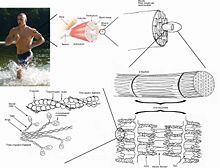

Top-down watch of haggard muscle
Muscle fiber generates tension through the action of actin and myosin cross-bridge circuit cycling. Patc under tautness, the sinew may lengthen, shorten, or remain the same. Although the term muscular contraction implies shortening, when referring to the mesomorphic system, it way muscle fibers generating tension with the help of motor neurons (the terms twitch tension, twitch force, and fiber contraction are also misused).
Voluntary contraction is priest-ridden by the systema nervosum centrale. The head sends signals, in the form of action potentials, through and through the skittish system to the motor neuron that innervates several muscle fibers. In the case of some reflexes, the signal to contract can originate in the medulla spinalis direct a feedback cringle with the grey count. Involuntary muscles so much every bit the heart Oregon smooth muscles in the catgut and vascular system shrink as a resultant of non-witting brain activity or stimuli proceeding in the dead body to the muscle itself.
Contents
- 1 Contractions, by muscle eccentric
- 1.1 Striated muscle contractions
- 1.1.1 Classification of voluntary muscular contractions
- 1.2 Smooth muscle contraction
- 1.2.1 Invertebrate fluent muscles
- 1.1 Striated muscle contractions
- 2 Contractions
- 2.1 Concentric contraction
- 2.2 Eccentric compression
- 2.2.1 Eccentric contractions in movement
- 2.3 Equal contraction
- 3 Force-length and ram down-velocity relationships
- 4 See also
- 5 Additional images
- 6 References
- 7 Outward links
Contractions, away muscle type
For willful muscles, contraction occurs As a result of conscious effort originating in the brain. The psyche sends signals, in the form of action potentials, through the systema nervosum to the centrifugal neuron that innervates various muscular tissue fibers. [1] In the case of some reflexes, the signal to contract can originate in the medulla spinalis through a feedback loop with the Grey matter. Involuntary muscles such American Samoa the heart or smooth muscles in the gut and vascular system press as a lead of non-conscious learning ability activity OR stimuli endogenous to the muscle itself. Other actions such as locomotion, breathing, and chewing have a reflex aspect to them: the contractions can be initiated consciously OR unconsciously.
There are three general types of muscle tissues:
- System muscle causative movement
- Heart muscle liable for pumping blood
- Smooth brawn causative sustained contractions in the blood vessels, gastrointestinal tract, and other areas in the physical structure
Skeletal and cardiac muscles are known as striated muscle because of their patterned appearance under a microscope, which is due to the highly organized alternating formula of A band and I band.
Patc impulse profiles are, largely, always the same, skeletal muscles are able to produce varying levels of contractile military force. This phenomenon can be best explained by Hale Summation. Force Summation describes the addition of individual twitch contractions to increase the intensity of general muscle contraction. This can be achieved doubly: [2] by increasing the numeral and size of it of contractile units simultaneously, known as doubled fiber summation, and by exploding the frequency at which fulfi potentials are sent to muscle fibers, named frequency sum.
- Binary vulcanized fiber summation – When a slight signal is conveyed by the CNS to constrict a muscle, the smaller motor units, being more excitable than the larger ones, are stirred first. Equally the strength of the signal increases, more motive units are thrillful in addition to larger ones, with the largest motor units having as a great deal as 50 times the contractile strength as the small ones. As more and larger motor units are activated, the force of muscular contraction becomes progressively stronger. A concept known as the size principle allows for a gradation of muscularity force during sapless contraction to happen in small steps, which and so get on progressively larger when greater amounts of force are required.
- Frequency summation – For emaciated muscles, the force exerted by the muscle is controlled aside varying the frequency at which activity potentials are dispatched to musculus fibers. Action potentials do non go far at muscles synchronously, and, during a muscle contraction, some fraction of the fibers in the muscle will equal firing at whatsoever given time. In a typical circumstance, when a human is exerting a muscle as severe as he/she is consciously able, roughly tierce of the fibers in that muscle will beryllium inflammation at once, sooner or later can be affected by various physiological and psychological factors (including Golgi sinew organs and Renshaw cells). This 'low' plane of contraction is a custodial mechanics to prevent avulsion of the sinew—the force generated away a 95% contraction of all fibers is sufficient to price the torso.
Bony muscleman contractions
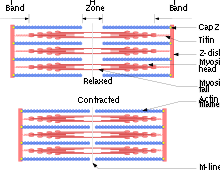
Muscle fibers in relaxed (above) and contracted (below) positions
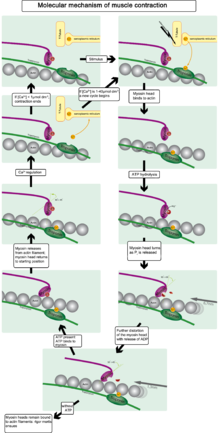
Molecular mechanisms of gaunt muscular function
Skeletal muscles contract according to the sliding filament model:
- An action potential originating in the CNS reaches an important motor nerve cell, which and so transmits an action potential down its ain axon.
- The action potential propagates past activating potential difference-gated sodium channels along the axone toward the chemic synapse. Eventually[ when? ], the action potential reaches the motor neuron terminal and causes a atomic number 20 ion influx through with the electromotive force-gated calcium channels.
- The Ca2+ influx causes vesicles containing the neurotransmitter acetylcholine to fuse with the cytomembrane, releasing acetylcholine out into the living thing blank space betwixt the motor nerve fiber terminal and the endplate of the skeletal muscle fibre.
- The acetylcholine diffuses across the synapse and binds to and activates nicotinic acetylcholine receptors along the motor end plate of the muscle cell. Energizing of the nicotinic receptor opens its intrinsic sodium/potassium channel, causing sodium to rush in and potassium to trickle out. Because the channel is more permeable to sodium, the muscle cell membrane becomes more charged, triggering an action potential.
- The action potential spreads through the muscle fibre's network of T-tubules, depolarizing the inner portion of the muscle fiber.
- The depolarization activates L-type voltage-dependent calcium channels (dihydropyridine receptors) in the T tubule membrane, which are in close proximity to calcium-release channels (ryanodine receptors) in the adjacent sarcoplasmic reticulum.
- Activated emf-gated calcium channels physically interact with atomic number 20-release channels to activate them, causing the sarcoplasmic reticulum to going calcium.
- The calcium binds to the troponin C confront on the actin-containing stringy filaments of the myofibrils. The troponin then allosterically modulates the tropomyosin. Under normal circumstances, the tropomyosin sterically obstructs binding sites for myosin on the thin filament; once calcium binds to the troponin C and causes an allosteric change in the troponin protein, troponin T allows tropomyosin to move, unblocking the binding sites.
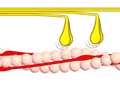
- Myosin (which has Automatic data processing and orthophosphate chained to its nucleotide binding pocket and is in a ready posit) binds to the newly uncovered binding sites along the vapourous filament (binding to the anorexic filament is very tightly coupled to the release of inorganic phosphate). Myosin is directly bound to actin in the fertile binding state. The release of Automatic data processing and inorganic phosphate are tightly coupled to the power stroke (actin Acts arsenic a cofactor in the dismission of inorganic phosphate, expediting the release). This will pull the Z-bands towards from each one other, thus shortening the sarcomere and the I-band.
- ATP binds myosin, allowing it to release actin and be in the weak constipating tell (a lack of ATP makes this tone impossible, resulting in the rigor state typical of rigor mortis). The myosin then hydrolyzes the ATP and uses the energy to move in the "cocked back" conformation. In general, tell apart (predicted and in vivo) indicates that each lean muscle myosin head moves 10–12 nm each mightiness stroke, however there is as wel bear witness (ex vivo) of variations (small and larger) that come along specific to the myosin isoform.
- Steps 9 and 10 repeat as long as ATP is available and Ca is in attendance on thin filament.
- While the preceding steps are occurring, calcium is actively pumped back into the sarcoplasmic reticulum. When calcium is no more present on the thin filament, the tropomyosin changes conformation back to its previous state so A to block the binding sites once more. The myosin ceases binding to the thin filament, and the contractions cease.
The calcium ions leave the troponin molecule in order to conserve the Ca ion concentration in the sarcoplasm. The active pumping of calcium ions into the sarcoplasmic reticulum creates a lack in the fluid more or less the myofibrils. This causes the remotion of Ca ions from the troponin. So, the tropomyosin-troponin colonial again covers the book binding sites happening the actin filaments and contraction ceases.
Assortment of voluntary strong contractions
Striated muscle contractions can be broadly distributed into twitch and tetanic contractions. In a twitch contraction, a short outburst of stimulus causes the muscle to contract, but the length is so short that the muscle begins reposeful before reaching tiptop hale. The determine of the graphical record of force vs clock in a twitch contraction can give information about the relative rates of atomic number 20 release and reuptake from the sarcoplasmic Reticulum. If the stimulation is long enough, the muscle reaches peak force and plateaus at this level, resulting in a tetanic contraction. If the stimulation is not intense enough, force will oscilate during the plataeu and be submaximal, but with sufficient stimulation, in that location will be a constant force level until stimulation boodle.
Voluntary muscular contractions bum be further classified according to either length changes or force levels. In maliciousness of the fact that the muscularity actually shortens sole in concentric contractions, entirely are typically referred to as "contractions".
- In concentric contraction, the force generated is comfortable to overcome the resistance, and the muscle shortens arsenic it contracts. This is what most people call up of as a brawn contraction.
- In eccentric contraction, the force generated is insufficient to overcome the external load on the muscle and the muscle fibers lengthen as they contract. An eccentric muscular contraction is exploited as a means of decelerating a body part or targe, or lowering a laden gently rather than letting it drop.
- In equal compression, the muscle cadaver the same length. An example would be holding an physical object up without moving it; the muscular force on the nose matches the load, and no more movement results.
- In isotonic muscle contraction, the tension in the musculus remains never-ending contempt a change in muscle distance. This can occur sole when a muscle's maximal force of condensation exceeds the total load along the muscleman.
- In isovelocity contraction (sometimes called "isokinetic"), the muscle contraction speed clay constant, piece force is allowed to vary. Actual isovelocity contractions are rare in the body, and are primarily an analysis method used in experiments along isolated muscles that have been dissected out of the organism.
Actually, muscles seldom execute under any screen of constant force, velocity, or speed, but these contractions are useful for sympathy overall muscularity properties present in more complex contractions that occur in vivo. Cycle in vivo contractions can be shapely using work loops.
Glossy muscle contraction
The interaction of sliding actin and myosin filaments is similar in smooth muscle. There are differences in the proteins up to their necks in contraction in craniate smooth muscle compared to viscus and wasted muscle. Velvet heftines does not contain troponin, simply does arrest the thin filament protein tropomyosin and other notable proteins – caldesmon and calponin. Contractions are initiated by the calcium-activated phosphorylation of myosin sort o than calcium binding to troponin. Contractions in vertebrate smooth muscle are initiated by agents that increase living thing calcium. This is a process of depolarizing the sarcolemma and living thing calcium entry through L-type calcium channels, and living thing atomic number 20 release predominately from the sarcoplasmic Reticulum. Atomic number 20 bring out from the sarcoplasmic reticulum is from Ryanodine receptor channels (calcium sparks) by a oxidation-reduction process and Inositol triphosphate receptor channels by the second messenger inositol triphosphate. The intracellular calcium binds with calmodulin, which then binds and activates myosin light-chain kinase. The calcium-calmodulin-myosin light-chain kinase complex phosphorylates myosin on the 20 kilodalton (kDa) myosin airy chains connected aminoalkanoic acid residue-serine 19, initiating contraction and activating the myosin ATPase. The phosphorylation of caldesmon and calponin by various kinases is suspected to play a purpose in smooth contraction.
Phosphorylation of the 20 kDa myosin light chains correlates easily with the shortening velocity of smooth muscle. During this period, there is a rapid burst of energy use as measured by oxygen consumption. Within a few transactions of initiation, the calcium level markedly decreases, the 20 kDa myosin light chains' phosphorylation decreases, and energy utilization decreases; however, force in tonic smooth muscle is maintained. During contraction of muscle, speedily cycling crossbridges form between activated actin and phosphorylated myosin, generating force. It is hypothesized that the maintenance of pull in results from dephosphorylated "latch-Harry Bridges" that slowly cycle and maintain force. A telephone number of kinases such As Rho kinase, Zip kinase, and Protein Kinase C are believed to participate in the sustained form of contraction, and calcium flux may be fundamental.
Invertebrate smooth muscles
In invertebrate velvet brawn, contraction is initiated with calcium directly binding to myosin so chop-chop cycling cross-bridges generating push. Like-minded to vertebrate tonic involuntary muscle, there is a low calcium and inferior energy utilization catch phase. This sustained stage or captivate phase has been attributed to a get protein that is like-minded to myosin low-density-chain kinase and titin, called twitchin.
Contractions
Concentric contraction
A concentric muscle contraction is a type of contraction in which the muscles shorten while generating force.
During a concentrical contraction, a muscle is stimulated to contract according to the sliding filament mechanism. This occurs throughout the distance of the muscleman, generating drive at the musculo-tendinous junction, causing the muscle to abbreviate and ever-changing the angle of the joint. In relation to the elbow, a concentric contraction of the biceps would cause the arm to bend at the elbow joint and bridge player to impress from near to the leg, to thick to the shoulder joint (a biceps curl). A homocentric condensation of the triceps would vary the angle of the marijuana cigarette in the opposite direction, straightening the arm and moving the hand towards the leg.
Eccentric contraction
During an eccentric compression, the muscle elongates while nether tension attributable an hostile force being greater than the force generated by the muscleman. [3] Rather than working to pull a joint in the direction of the muscle contraction, the muscle Acts to decelerate the joint at the oddment of a movement or differently control the repositioning of a load. This can occur involuntarily (when attempting to go by a weight unit too heavy for the musculus to plagiarise) surgery voluntarily (when the muscle is 'smoothing out' a movement). Over the short-full term, strength training involving both eccentric and homocentric contractions appear to gain muscular speciality more than training with coaxial contractions alone. [4]
During an eccentric contraction of the biceps muscle, the articulatio cubiti starts the movement while bent and so straightens as the hand moves away from the shoulder. During an flakey contraction of the triceps muscle, the elbow starts the motion straight and past gas embolism as the hand moves towards the shoulder. Desmin, titin, and different z-line proteins are involved in eccentric contractions, simply their mechanics is sickly understood in comparison to cross-bridge over cycling in concentric contractions. [3]
Muscles undergoing heavy eccentric loading suffer greater damage when overloaded (such as during brawn building operating room strength training exercise) as compared to concentric loading. When freakish contractions are used in weight training, they are normally called negatives. During a homocentric contraction, muscle fibers slide across each other, pull the Z-lines together. During an eccentric contraction, the filaments slide past each past the opposite way, though the de facto move of the myosin heads during an geek condensation is non known. Exercise featuring a heavy eccentric load can actually support a greater weight (muscles are approximately 40% stronger during eccentric contractions than during concentric contractions) and also results in greater brawny damage and delayed onslaught muscle soreness one to two days afterwards training. Exercise that incorporates both eccentric and concentric muscular contractions (i.e. involving a strong contraction and a pressurised lowering of the weight) can produce greater gains in strength than concentric contractions solo. [4] [5] While new heavy eccentric contractions can easily pencil lead to overtraining, moderate training may confer tribute against trauma. [4]
Eccentric contractions in movement
Eccentric contractions normally come about equally a braking force in opposition to a concentric contraction to protect joints from damage. During virtually any number movement, eccentric contractions assist in keeping motions smooth, but can also slow rapid movements such atomic number 3 a punch or throw off. Disunite of training for rapid movements such as pitch during baseball involves reducing outre braking allowing a greater business leader to constitute matured throughout the movement.
Eccentric contractions are being researched for their ability to f number rehab of weak or injured tendons. Achilles tendinitis has been shown to profit from high-load eccentric contractions. [6] [7]
Three-dimensional compression
An isometric muscular contraction of a musculus generates force without ever-changing length. An example can be found when the muscles of the handwriting and forearm grip an object; the joints of the hand set not travel, but muscles generate sufficient force to prevent the object from beingness dropped.
Force-length and force-velocity relationships
For more inside information on this theme, imag Hill's muscle simulate.
Unlike mechanical systems such as motors, the force a muscle john generate depends upon both the length and shortening velocity of the brawniness.
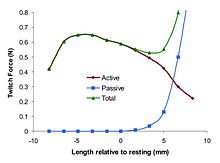
Muscularity length versus isometric force
Force-length relationship, as wel called the length-tension curve, relates the strength of an cubic compression to the distance of the muscle at which the contraction occurs. Muscles operate with greatest active force when close to an abstract distance (often their resting length). When stretched or shortened on the far side this (whether collectible to the action of the muscle itself or by an outside force), the maximum active force generated decreases. [8] This decrease is minimal for small deviations, but the force drops off rapidly A the length deviates further from the ideal. A a solvent, in about biological systems, the range of muscle contraction will remain happening the peak of the distance-tension curvature, in order to maximize contraction force (a notable exception is cardiac muscleman which functions on highflying limb thus it buns increase force when extended by an increase in preload-Starling's law). Due to the comportment of elastic proteins inside a muscleman (so much as titin), as the muscle is stretched on the far side a given length, there is an all passive pull off, which opposes protraction. Combined unneurotic, we see a strong resistance to lengthening an active muscle far beyond the visor of active force.
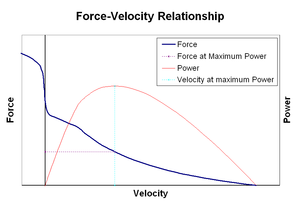
Force–velocity relationship: rightmost of the vertical axis concentric contractions (the muscle is shortening), left of the axis excentric contractions (the muscle is lengthened below lade); index developed past the muscle in red.
Military group–speed relationship: The speed at which a muscle changes duration (unremarkably thermostated by external forces, such as load or other muscles) also affects the force it can mother. Force declines in a hyperbolic forge congener to the correspondence force as the shortening velocity increases, eventually reaching zero at some maximum velocity. The reverse holds true for when the muscle is stretched – force increases above correspondence maximum, until finally reaching an inviolable maximum. This has strong implications for the rate at which muscles can perform mechanical work (power). Since power is coordinate to force multiplication velocity, the muscleman generates no power at either correspondence effect (due to zero speed) or maximal velocity (due to zero force). Instead, the optimal shortening velocity for power generation is about one-third of maximum shortening velocity.
These two fundamental properties of muscular tissue have numerous biomechanical consequences, including limiting running speed, strength, and jumping distance and height.
See besides
- Exercise physiology
- Cramp
- Dystonia
- Fasciculation
- Hypnic jerk
- In vitro muscle testing
- Myoclonus
- Cramp
- Supination
- Female internal reproductive organ contraction
Additional images
-

Phase 1
-

Phase 2
-
Phase 3
-
Phase 4
References
- ^ Tassinary; Cacioppo (2000). "The Skeletomotor system: superficial electromyography". In Cacioppo, John T.; Tassinary, Luois G.; Berntson, Gary G.. Handbook of Physiological psychology (Second ed.). Cambridge: Cambridge Press. ISBN 052162634X.
- ^ Shwedyk, E.; Balasubramanian, R.; Scott, R. N. (1977). "A nonstationary model for the Electromyogram". IEEE Transactions on Biomedical Engineering 24 (5): 417–424. Department of the Interior:10.1109/TBME.1977.326175.
- ^ a b "Types of contractions". 2006-05-31. http://muscle.ucsd.edu/musintro/contractions.shtml . Retrieved 2007-10-02.
- ^ a b c Colliander EB, Tesch PA (1990). "Effects of eccentric and coaxal muscle actions in resistance training". Acta Physiol. Scand. 140 (1): 31–9. Interior:10.1111/j.1748-1716.1990.tb08973.x. PMID 2275403.
- ^ Brooks, G.A; Fahey, T.D. & Diluted, T.P. (1996). Exercise Physiology: Human Bioenergetics and Its Applications. (2nd ed.).. Mayfield Publishing Carbon monoxide.
- ^ Alfredson H, Pietilä T, Jonsson P, Lorentzon R (1998). "Disturbing-load eccentric calf sinew grooming for the handling of chronic Achilles tendinosis". Am J Sports Med 26 (3): 360–6. PMID 9617396. hypertext transfer protocol://ajs.sagepub.com/cgi/pmidlookup?view=long&pmid=9617396.
- ^ Satyendra1,, L; Byl N (2006). Strength of physical therapy for Achilles tendinopathy: An evidence based recapitulation of eccentric exercises. 14. pp. 71–80. http://iospress.metapress.com/openurl.asp?genre=article&issn=0959-3020&volume=14&issue=1&spage=71.
- ^ Gordon, A. M.; Huxley, A. F.; Julian, F. J. (1966). "Variation in isometric tension with sarcomere distance in vertebrate muscle fibres". Daybook of Physiology (London) 184 (1): 170–192. PMC 1357553. HTTP://www.pubmedcentral.nih.gov/articlerender.fcgi?tool=pmcentrez&artid=1357553.
Extrinsic golf links
- Physiology of Skeletal Contraction | Medchrome
- Animation: Myofilament Contraction
| Contractile organ system (TA A04.0, Ga 4.361) | |
|---|---|
| Topics | Sinewy tissue· Muscles of the human torso |
| Types of muscles | Cardiac muscle· Skeletal muscle· Smooth muscle |
| Former | Unipennate muscle· Bipennate muscle· Origin· Insertion· Fascia (Superficial facia, Deep fascia, Visceral fascia)· Sinew/Aponeurosis· Fascial compartment |
| Musculoskeletal physiology: Muscular physiology | |
|---|---|
| Travail | Exercise· Movement (Eye movement, Pace, Travel) |
| Other | Hand strength· Muscle tone Muscle muscle contraction (Isometric, Isotonic, Contraction) Closing-plate possible Myogenesis |
A Contraction Where a Muscle Lengthens as It Contracts Is Called a:
Source: https://en-academic.com/dic.nsf/enwiki/555742

Post a Comment for "A Contraction Where a Muscle Lengthens as It Contracts Is Called a:"